
AI can give you the answer.
Learning should
give you the ability.
Radically Chinese is built around a simple premise:
The purpose of learning is not simply to carry more information in your head,
but to build capabilities you can apply to what comes next.
Learners spend years memorizing vocabulary, learning the new and forgetting the old.
Characters still stubbornly look like random squiggles.
Reading stays painfully slow.
In listening, by the time you catch one familiar sound,
the conversation has already moved on.
Meanwhile, machines can retrieve, translate, and
generate answers almost instantly.
Why are we still treating language learning as an act of memorization,
when it is fundamentally,
a skill of information processing to be built?
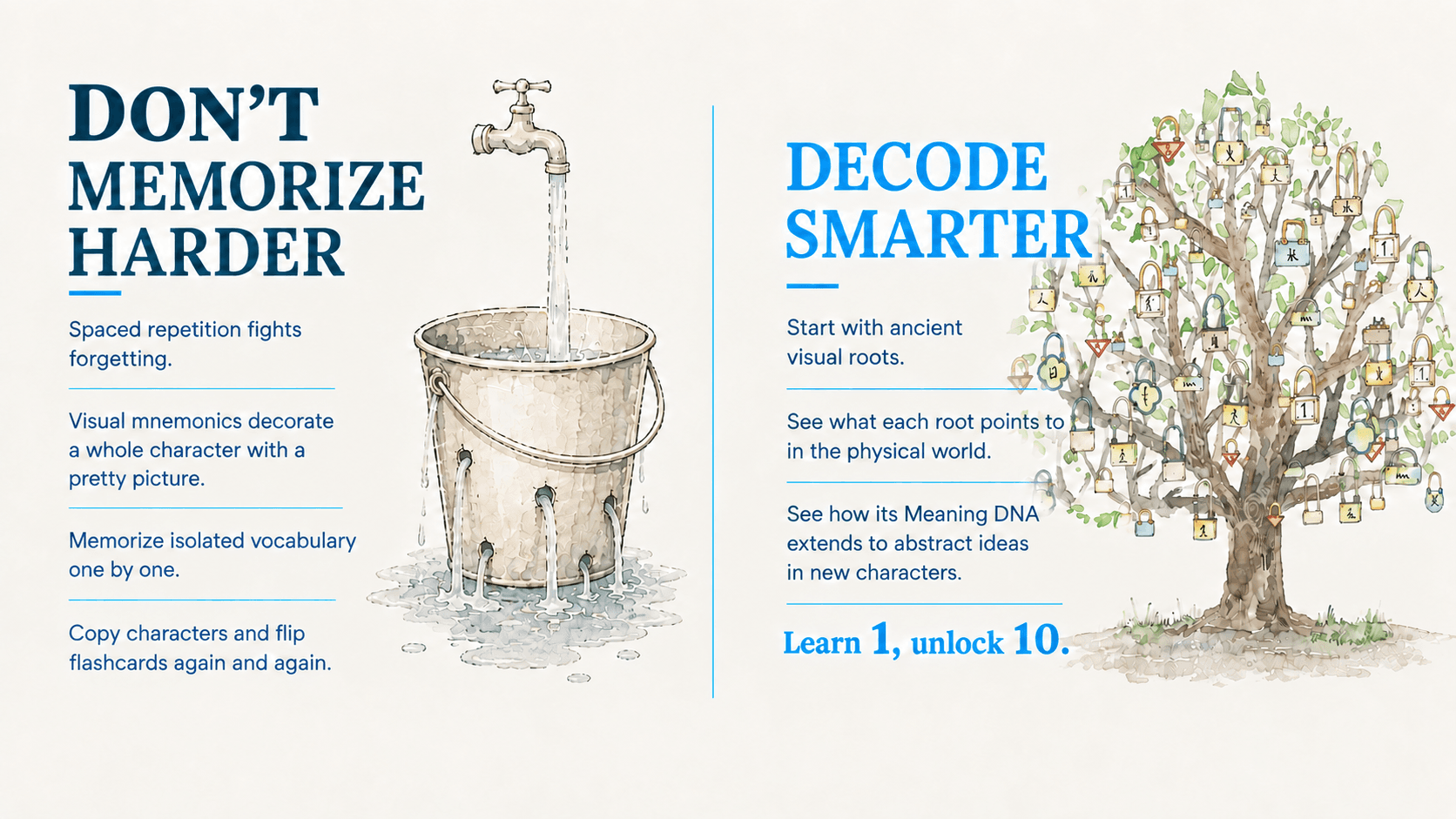
This is not a “Chinese is easy” promise. (We hate that kind of oversimplification.)
Nor is it a collection of arbitrary visual mnemonic tricks. (Arbitrary and unscalable.)
Radically Chinese grows out of a pedagogy developed over twelve years around
two simple truths: effective language learning must honor the linguistic nature of the language being learned, and the
cognitive nature of the human brain doing the learning.
For Chinese, that means aligning learning with both the
visual-semantic structure of written Chinese and the
brain’s natural capacity to recognize patterns, connect meaning, make inferences, build mental structure, and ultimately process language automatically.
At the foundation of Radically Chinese are Beacon–Anchor Theory and the Total Radical System™.
Beacon–Anchor Theory applies concepts and the framework of
Claude Shannon’s classic Information Theory to second-language acquisition (SLA).
Twelve years in the making.
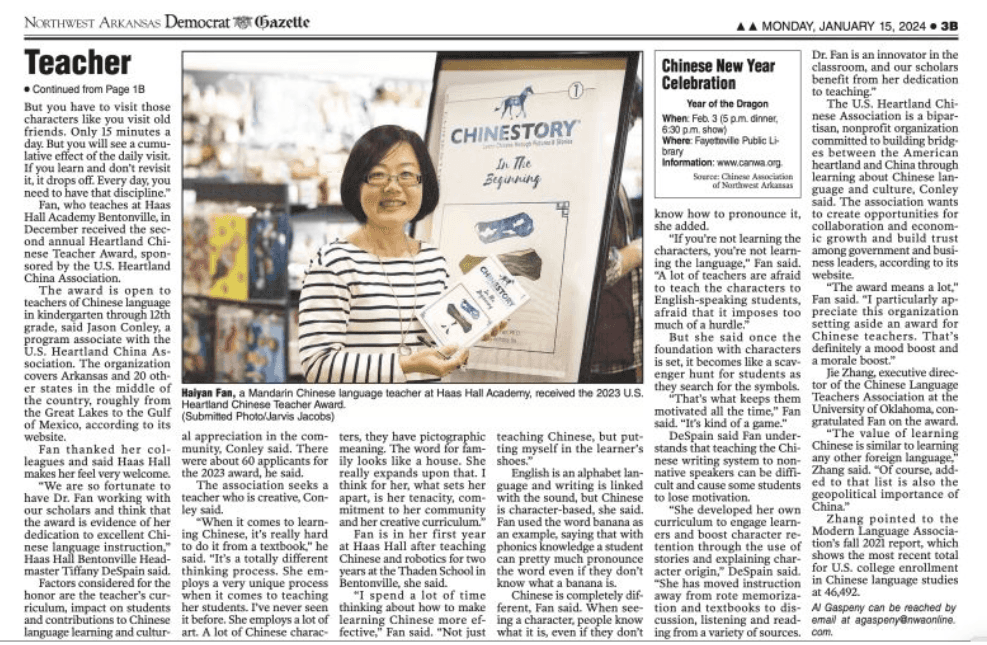
The research behind Radically Chinese began twelve years ago, when I started teaching Chinese at home as a mother trying to keep my children’s heritage language alive in the United States.
I wanted Chinese to feel alive, meaningful, and connected to their lives—
not like a Sunday-school burden they had to endure.
One early expression of that work became my illustrated Chinese character storybook,
In the Beginning—bringing together a fictional teenage adventure story, character visualization, and etymological research
to make Chinese characters STICK.
In 2019, that work took shape as an iF International Design Award-winning educational concept and later became the heart of my TEDx talk, How to Learn Chinese in the 21st Century.
Since then, the pedagogy has been used in classrooms and high-school curricula and tested with hundreds of learners around the world,
from age five to seventy-five.
Along the way, I coached two national champions in the U.S. National Chinese Speech Contest in 2023 and 2024.
In 2027, the methodology will reach a wider audience through a 24-episode Great Courses series, following a pilot course rated 4.9/5, with 100% recommendation by viewers.
Stay in the loop.
Radically Chinese is still unfolding.
New ideas. New experiments. Research. Conversations. Book. Collaborations.
And a few things I’m not quite ready to unveil yet.
If this way of thinking about language learning and teaching resonates with you,
leave your email.
I’ll write when there’s something
worth sharing.